

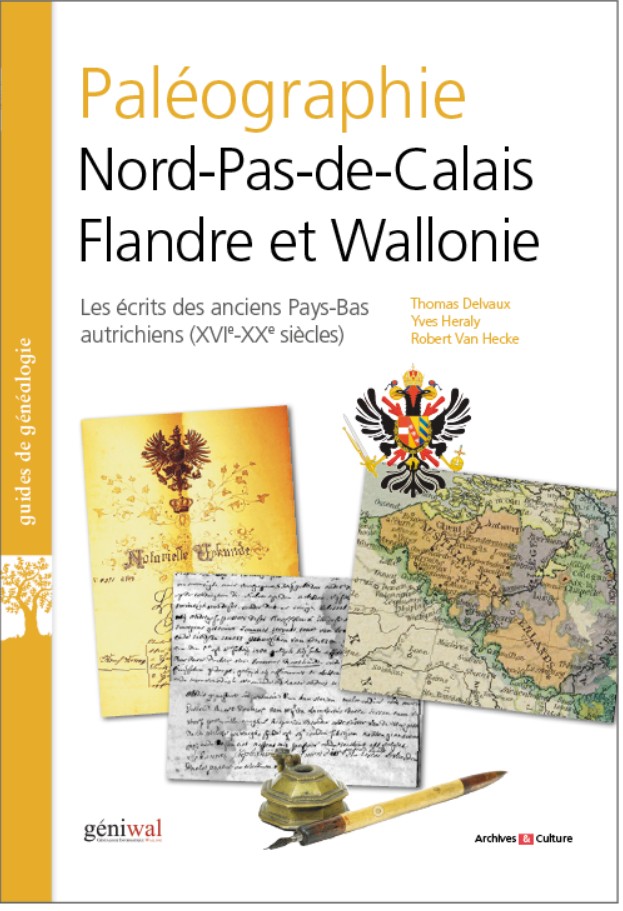
It's impossible to do genealogy without encountering problems deciphering old documents at one time or another. Regular, repeated and, above all, progressive reading of old documents contributes to the individual learning of palaeography. But this may seem a long time to the impatient researcher or the person working on digitised archives online, which are a little less easy to read. As for those who are moving on from parish registers to immerse themselves in notarial, legal or tax documents, they encounter new difficulties linked to professional abbreviations and feel the need for a tool to help them.
Last but not least, the region's specific characteristics are an additional obstacle for anyone unfamiliar with local archives. This vast region, historically defined as the former Austrian Netherlands, now straddles several countries, including France and Belgium. It presents difficulties linked to the language used (often Latin, but also, depending on the region and the period, Flemish, German and French) and the writing (Gothic in the eastern regions).
The aim of this book of Franco-Belgian palaeography (16th-20th centuries) is to teach you to read faster and better than if you were left to face the texts alone, and to help you discover the historical developments that have implications for genealogical research.
The aim of this book of Franco-Belgian palaeography (16th-20th centuries) is to teach you to read faster and better than if you were left to face the texts alone, and to help you discover the historical developments that have implications for genealogical research.
The three authors are members of the GéniWal association for computer genealogy in Wallonia.
Thomas Delvaux publishes articles on www.morinie.com to bring the history of Hauts-de-France to the attention of the general public. He has published several historical and genealogical works, including L'histoire et généalogie des Van Pradelles (2016).
Yves Heraly, former treasurer of the Cercle d'histoire, d'archéologie et de généalogie de Wavre et du Brabant wallon, founded the GéniWal association (Généalogie Informatique Wallonie) in 1998, of which he is president.
Robert Van Hecke, a member of GeniWal since its inception, gives palaeography courses to the Namur and Walloon Brabant sections. He writes articles for the Mouvement dynastique belge, Brabant wallon section, on the first Belgian medals and the volunteers of the Belgian revolution of 1830.


