

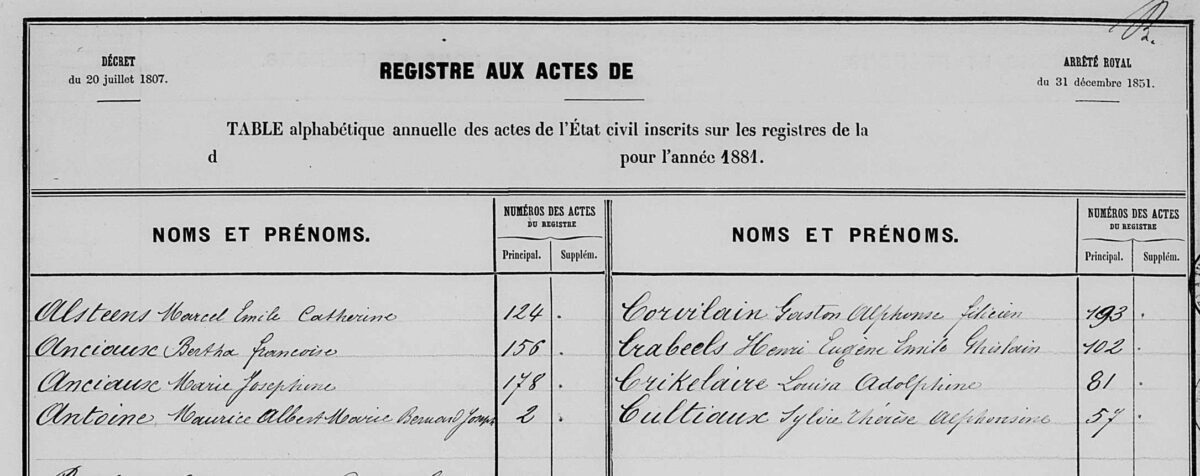
4. Alphabetical tables.
Article 2 of the imperial decree of 20 July 1807 states:
The annual tables will be drawn up by the civil registrars, in the month following the closure of the register for the previous year; they will be appended to each of the double registers; and, to this end, our imperial procurators (King's procurators) will ensure that a double copy is sent by the mayors (burgomasters) to the court clerk's office, within three months of the deadline.
A royal decree of 31 December 1851 (Monit. of 8 January 1852) set out the formalities to be followed for the formation of annual tables.
Art. 1. - The annual alphabetical tables of civil status registers, sent in compliance with the decree of 20 July 1807, will be drawn up in the following form:
Province of ...
Arrondissement de ...
Canton of ...
Municipality of ...
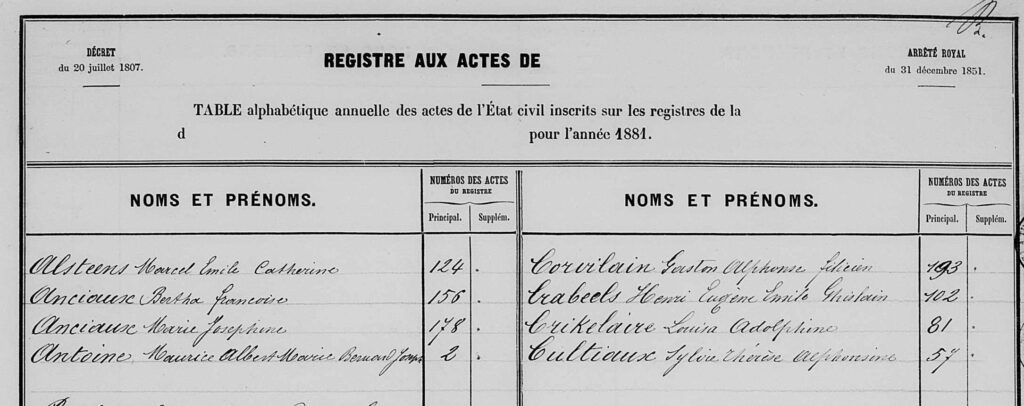
Annual alphabetical table of civil status records entered in the registers of the municipality of Namur for the year 1881
Art. 3. - The names entered in the tables of the supplementary registers will also be entered, in alphabetical order and according to the nature of the acts to which they relate, in the tables of the main registers.
Art. 4. - When closing the tables, civil registrars will check that the names entered in the tables of the additional registers have been included in the respective tables of the main registers and, if there are no additional registers, they will certify that none exist.
Art. 5. - The tables in the registers of marriage and death certificates will include the widowed woman in alphabetical order of her surname and that of her first husband, and even previous husbands if they were mentioned in the said certificates.
Art. 6. - Names will begin with or precede the letter immediately following the letters D and V in alphabetical order.
Art. 7. - In all cases where marginal entries are made in the civil status registers, they will also be entered in the tables in the manner prescribed by art. 49 of the Civil Code.
Art. 8. - At the end of each table, two or three blank lines will be left to record any corrections or errors.
Art. 9. - The Ministers of the Interior and of Justice are each responsible for the execution of this decree.
Art. 5 of the decree of 20 July 1807 instructed the clerks of the courts of first instance to draw up ten-yearly tables of civil status records during the first six months of the eleventh year. Under the terms of art. 5, three copies were to be made for each commune, one to be sent to the registry, the second to the provincial governors and the third to each commune within the jurisdiction of the court.
The law of 2 June 1861 (Monit. of 5) abolishes the dispatch intended for the provincial governors, and decides that the clerks will receive one cent per name, for the dispatch which must be sent to the communes.
Each sheet must contain 96 names or lines (Art. 6 of the decree.)
The annual and decennial tables will be drawn up on stamped paper and certified by the respective depositaries. (Art. 4 id.)
5. Publicity of registers. - Extracts. Fees payable for their issue.
Art. 45, C. civ. - Any person may obtain extracts from the civil status registers (civil registrar and court clerk). Extracts issued in conformity with the registers and legalised by the president of the court of first instance or by the judge who replaces him or her will be authentic until they are forged (1).
Observations. —
a. The municipal clerk or any other employee may not issue extracts.
b. The fees to be charged for the issue of copies or extracts of civil status records are set by the decree of 24 May 1827 (J. off., XXII, n° 27) which bears :
Art. 1. - In future, 40 cents (85 centimes) will be charged for the issue of each copy of or extract from a marriage, adoption or divorce record, and for the...
Next: Registration and drafting of deeds


